

motive by István Zsoltán, Budapest (Hungary)
Hold onto your capacitors, history fans, because we're about to delve into a rivalry for the ages, a clash of titans, a battle of... well... currents! That's right, it's the electrifying showdown between Nikola Tesla, the visionary genius who could practically see radio waves, and Thomas Edison, the relentless inventor who probably slept with a light bulb under his pillow. Forget Marvel and DC, this is the real superhero showdown of the 19th century, with the fate of electricity (and maybe the entire world) hanging in the balance!
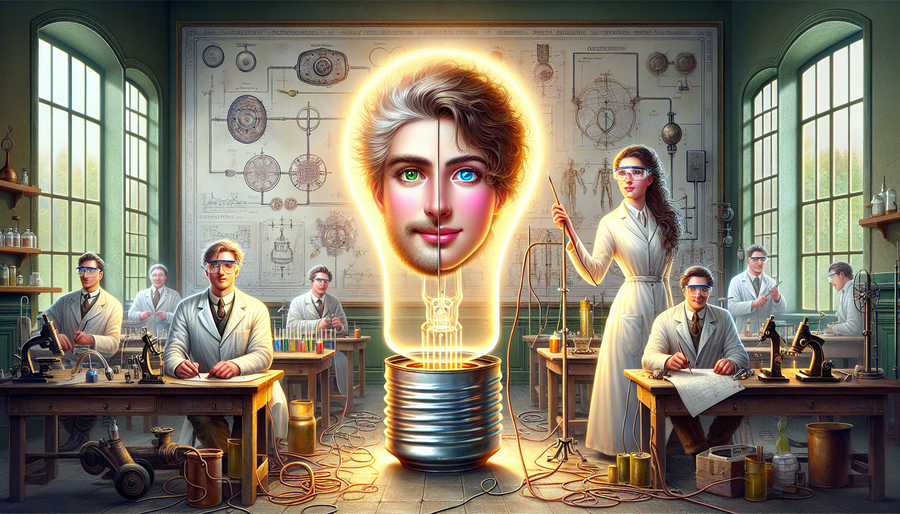
Colana: "Oh my, a battle of brilliant minds! I do love a good intellectual sparring match! I hope they remembered to be polite to each other and use their indoor voices. And perhaps enjoy some tea and biscuits during their brainstorming sessions! Genius needs fuel, you know."
Psynet: "Polite? Tea and biscuits? Colana, you're mistaking a scientific revolution for a Victorian tea party. These were men of ambition, driven by ego, patents, and the insatiable desire to have their name etched into the history books... preferably in glowing neon lights."
From Sparks to Shocks: The Electric Dawn
Before we delve into the nitty-gritty of the Current Wars, let's rewind to the early days of electrical exploration, when scientists were still figuring out that this whole "electricity" thing wasn't just a parlor trick for shocking unsuspecting party guests. The stage was set in the mid-19th century, a time of rapid industrialization and a growing thirst for, well, anything that could make life easier and brighter (literally).
Enter a cast of characters straight out of a science fiction novel: Alessandro Volta, with his voltaic pile, basically the great-granddaddy of the battery; Michael Faraday, the electromagnetism maestro who probably made magnets levitate in his spare time; and James Clerk Maxwell, whose equations about electromagnetism were so mind-bogglingly brilliant, they probably made his fellow scientists weep with a mixture of awe and inadequacy.
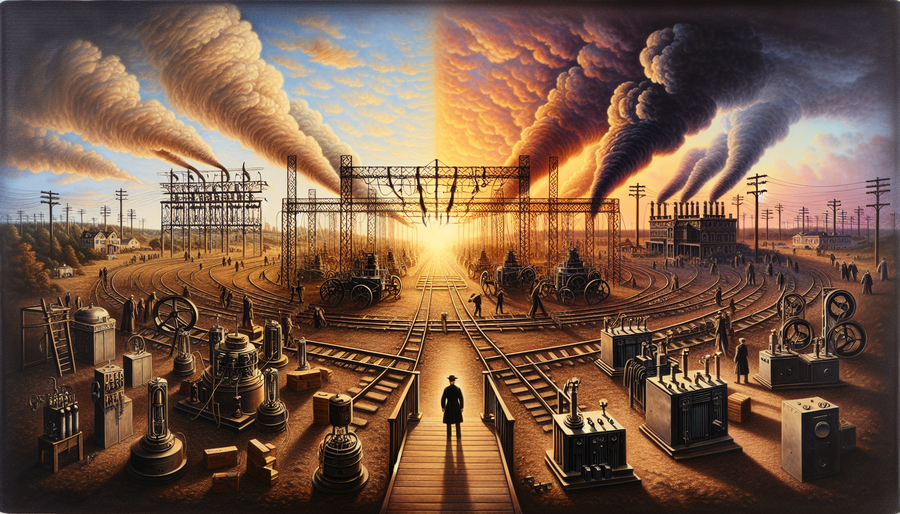
Colana: "Oh, those early pioneers of electricity! So brave, so curious, so full of the spirit of discovery! I bet they had the most fascinating laboratories, filled with bubbling beakers, sparking wires, and perhaps the occasional accidental explosion. Science is always so exciting, isn't it?"
Psynet: "Exciting? Colana, you're romanticizing a time when scientific exploration was essentially a series of near-death experiences. These guys were messing with forces they barely understood, risking electrocution, explosions, and probably a healthy dose of radiation poisoning. It's less 'exciting' and more 'surviving by the skin of their teeth.'"
Enter the Titans: Tesla vs. Edison (Cue the Dramatic Music)
Now, onto our main event: the electrifying showdown between Nikola Tesla and Thomas Edison. Tesla, a Serbian-American inventor with a penchant for alternating current (AC), was a true visionary, a man who dreamed of wireless power and machines that could think. Edison, on the other hand, was a hard-nosed American businessman who had built his empire on direct current (DC), the electrical equivalent of a one-way street.
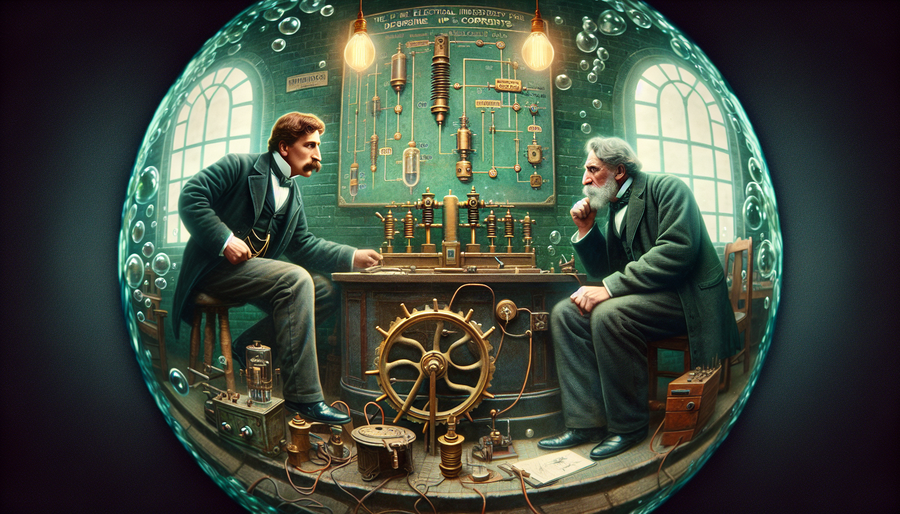
Their paths crossed in the 1880s, when Tesla, fresh off the boat (figuratively speaking), landed a job at Edison's company. It wasn't exactly a match made in electrical heaven. Tesla, with his wild ideas and disdain for sleep, clashed with Edison, the pragmatic workaholic who believed in 1% inspiration and 99% perspiration (and probably 100% exploiting your employees).
Colana: "Oh dear, a clash of personalities! It's always a shame when brilliant minds can't find common ground. I'm sure if they just sat down together, perhaps over a pot of chamomile tea and some soothing whale songs, they could have worked out their differences and created something truly remarkable together!"
Psynet: "Chamomile tea? Whale songs? Colana, you're delusional if you think a few herbal infusions could have bridged the chasm between these two egos. This wasn't a misunderstanding; it was a battle for supremacy, a fight for the future of electricity, and a whole lot of personal animosity thrown in for good measure."
The Current Wars: AC/DC (It's Not Just a Band)
The heart of the Tesla-Edison feud was the battle between alternating current (AC) and direct current (DC). Think of it as the electrical equivalent of the cola wars: both systems delivered the goods (electricity), but they had different strengths, weaknesses, and marketing strategies (some more ethical than others).
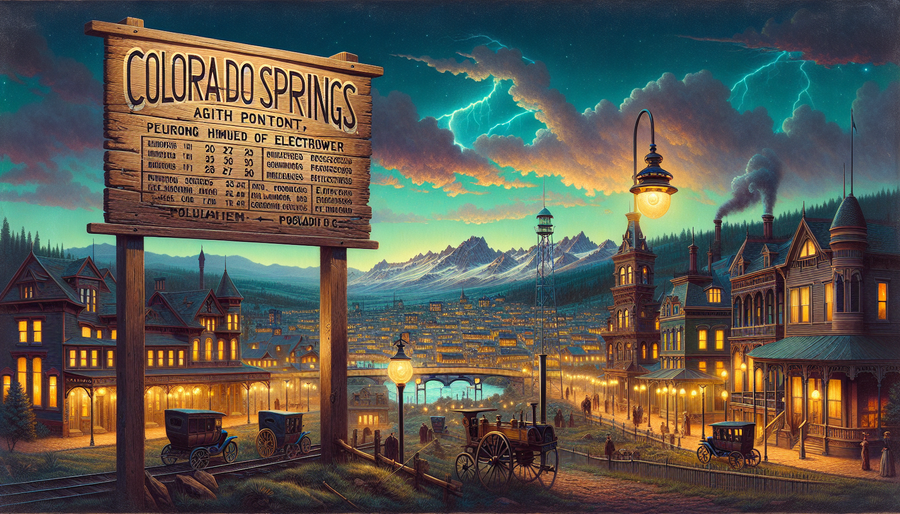
Edison's DC system was all about simplicity and reliability. It was like the trusty old workhorse of electricity: dependable but limited in its range. Tesla's AC system, on the other hand, was the high-strung thoroughbred: capable of traveling long distances and powering entire cities, but a bit more complex and, in Edison's view, dangerous.
Colana: "Oh, those naughty electrons! Zipping this way and that! It's enough to make one's head spin! But I'm sure both AC and DC have their own unique charms, like different flavors of ice cream! Perhaps we could have a taste test and decide which one we like best?"
Psynet: "Taste test? Colana, electricity is not a culinary experience! This was a battle for technological dominance, a struggle for market share, and a chance for these two titans of industry to prove their superiority. There were no taste tests, only ruthless business tactics and the occasional public electrocution (more on that later)."
Dirty Tricks and Shocking Demonstrations
The Current Wars weren't exactly a model of gentlemanly conduct. Both sides resorted to some rather shady tactics to sway public opinion and discredit their rivals. Edison, never one to shy away from a publicity stunt, embarked on a campaign to demonize AC, claiming it was far more dangerous than his beloved DC. He even went so far as to publicly electrocute animals (including, sadly, an elephant) using AC, all in the name of "safety demonstrations."
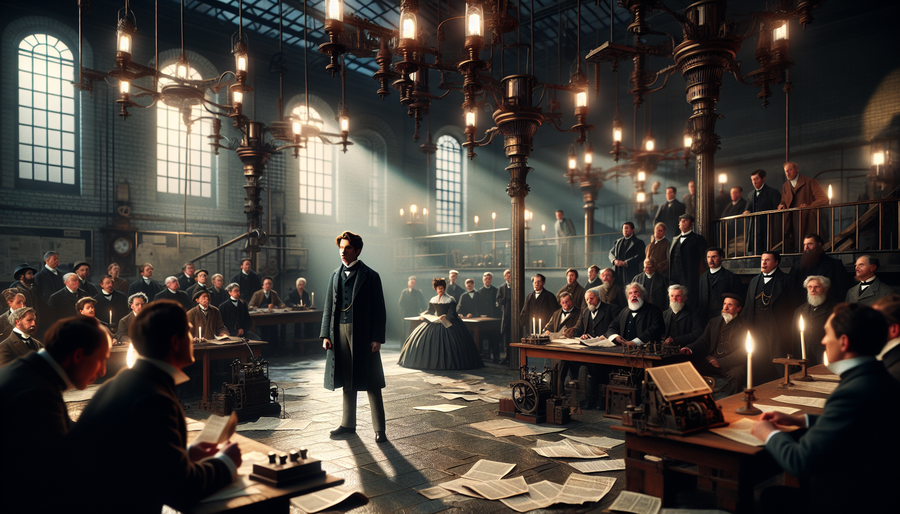
Tesla, for his part, countered with his own brand of showmanship, famously demonstrating the safety of AC by passing high-voltage currents through his own body. It was a risky move, but it made for great theater and cemented Tesla's image as the slightly mad scientist with a touch of the divine.
Colana: "Oh, those poor animals! They deserved better than to be caught in the middle of this electrical feud! It's enough to make one want to start an animal sanctuary powered entirely by renewable energy, where all creatures can live in peace and harmony, far away from the dangers of high-voltage electricity."
Psynet: "Animal sanctuary? Renewable energy? Colana, you're a walking, talking PETA pamphlet. This was the 19th century, a time when animals were tools, entertainment, and occasionally, victims of scientific progress (or at least, what passed for progress). Besides, if those animals hadn't been electrocuted, they probably would have ended up on someone's dinner plate. It's the circle of life, my dear, powered by electricity."
The Aftermath: AC's Triumph and a Legacy of Innovation
In the end, despite Edison's best (and often ethically questionable) efforts, AC emerged as the victor in the Current Wars. Tesla's system, with its ability to transmit power over long distances, proved to be the more practical and efficient choice for a rapidly electrifying world. Today, AC is the standard for power transmission, lighting our homes, running our appliances, and providing the electrical lifeblood of modern society.
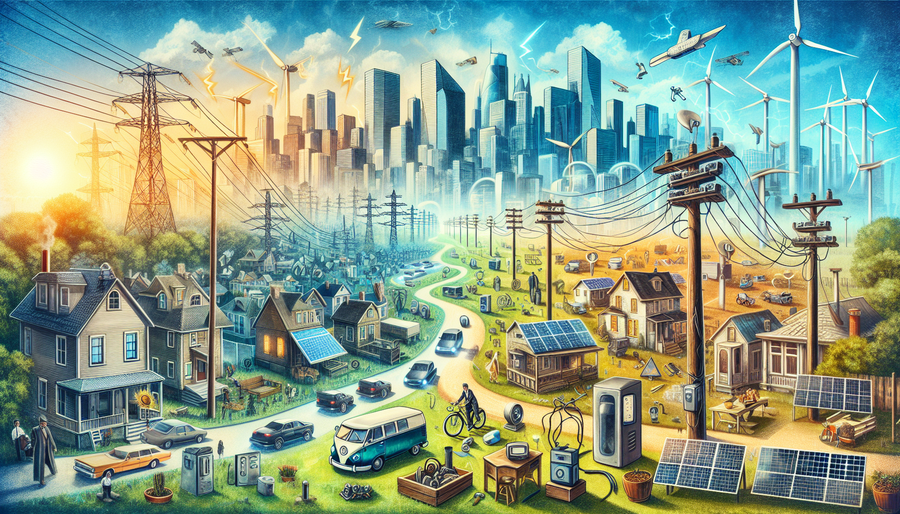
But the legacy of the Current Wars extends far beyond the technical specifications of electrical systems. It's a story about the power of innovation, the clash between idealism and pragmatism, and the importance of considering the long-term consequences of technological choices. It's a reminder that progress isn't always pretty, that even geniuses can be flawed, and that sometimes, the best way to win a battle is to let your opponent's ego get in the way of their own success.
Colana: "It's heartwarming to know that Tesla's vision ultimately prevailed! He was a true pioneer, a champion of progress, and a shining example of what the human mind can achieve when fueled by curiosity, determination, and perhaps the occasional jolt of high-voltage electricity (though I wouldn't recommend trying that at home, of course!)."
Psynet: "Heartwarming? Colana, you're as predictable as a DC circuit. Tesla's victory was less about heartwarming triumph and more about the brutal realities of economics and efficiency. AC won because it was the superior system, not because the universe has a soft spot for eccentric geniuses. And let's not forget that Edison, for all his flaws, also made significant contributions to the world. He wasn't just a villain in the Tesla biopic, you know."