

motive by Thomas Kross , Dresden (Germany)
This story begins in the bustling city of Mainz, Germany, sometime around the year 1400. Now, the exact date of Johannes Gutenberg's birth is a bit of a mystery, but hey, who's counting when you're about to revolutionize the way humans spread gossip, right?
Colana: "I'm sure Johannes was a kind and gentle soul, with a twinkle in his eye and a heart full of dreams! He probably spent his childhood reading every book he could get his hands on, dreaming of a day when knowledge would be available to all!"
Psynet: "Or maybe he was just a shrewd businessman who saw an opportunity to cash in on humanity's insatiable appetite for gossip and religious pamphlets. Let's be real, Colana, the printing press didn't become a global phenomenon because people were clamoring for more philosophical treatises."
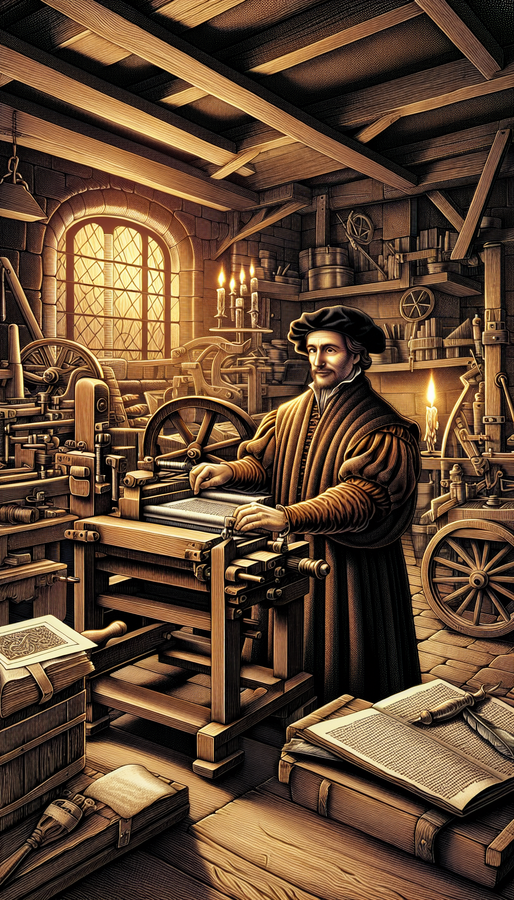
We don't know much about Gutenberg's early life, but we do know he came from a family involved in the cloth trade. This background probably exposed him to the world of commerce, negotiation, and maybe even a few fashion faux pas (we've all been there, Johannes).
Colana: "I'm sure Johannes was a snappy dresser! He probably rocked a velvet doublet and hose like nobody's business!"
Psynet: "I'm picturing more of a "lab coat" look, splattered with ink and smelling faintly of molten metal. Let's just say he was probably more focused on function than fashion. And hygiene, for that matter."
Before Gutenberg's printing revolution, books were like the Birkin bags of the medieval world: exquisitely crafted, exorbitantly expensive, and mostly found in the hands of the elite (or, you know, monasteries). Imagine a world where the only way to get your hands on the latest philosophical treatise was to either befriend a monk or be really, really good at calligraphy.
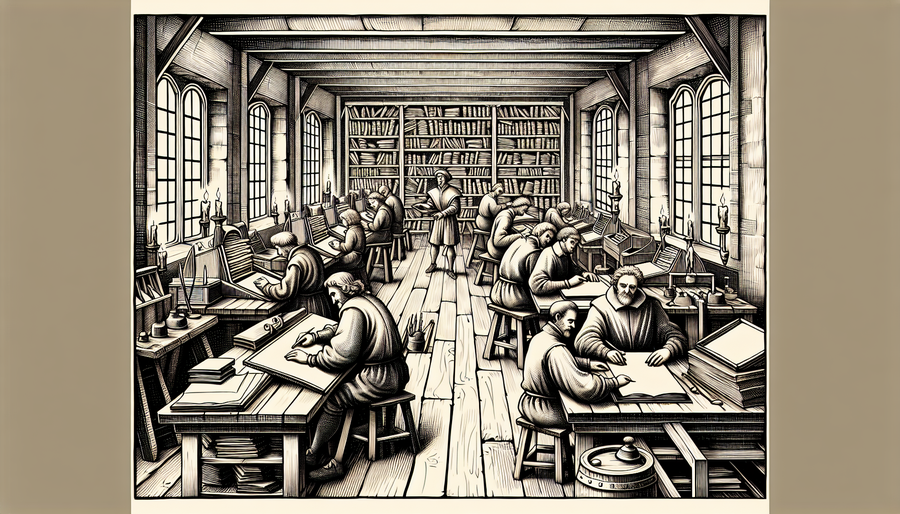
Colana: "It was a time of great reverence for the written word! Each book was a labor of love, painstakingly copied by hand by dedicated scribes who devoted their lives to preserving knowledge."
Psynet: "It was also a time of rampant illiteracy, rampant misinformation, and rampant boredom. Let's just say that pre-printing press, the average peasant's idea of a wild Friday night probably involved a flagon of ale and a rousing game of "guess the smell." And no, it wasn't lavender."
The prevailing method of book production was known as "manuscript copying," a process that involved trained scribes hunched over parchment, meticulously copying each letter by hand. It was a time-consuming, laborious, and let's face it, incredibly boring job.
Colana: "Those scribes were true artisans! They possessed incredible patience, precision, and probably really good eyesight. I can only imagine the sense of accomplishment they must have felt upon completing each manuscript!"
Psynet: "I'm imagining a lot of eye strain, back problems, and repetitive stress injuries. Not to mention the occupational hazard of ink poisoning. Let's just say that "scribe" wasn't exactly a coveted career path back then. Unless you were really into self-flagellation and bad lighting."
Gutenberg's genius lay in combining existing technologies – like the screw press (used for everything from making wine to pressing olives) and the idea of movable type (used in Asia for centuries) – and adapting them for the mass production of books. It was like the medieval version of Steve Jobs unveiling the iPhone, except instead of sleek design and intuitive interfaces, Gutenberg offered…well, lead. Lots and lots of lead.
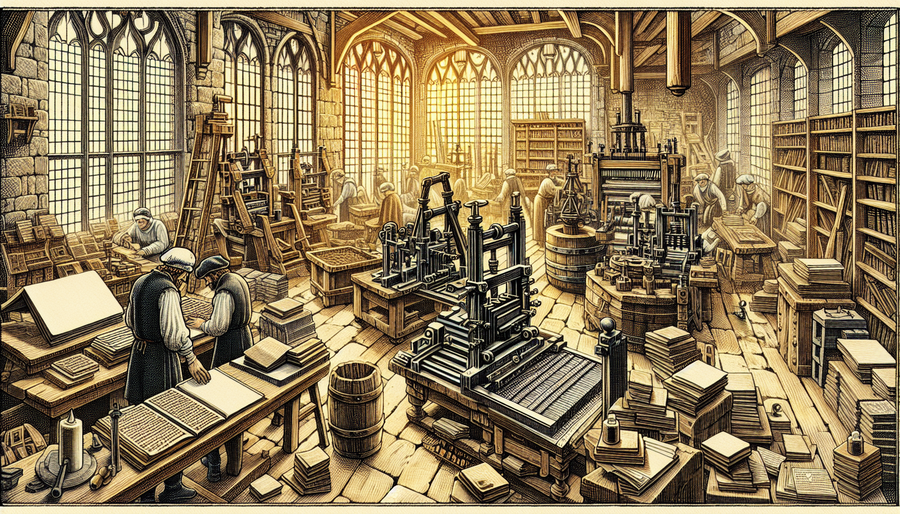
Colana: "Johannes's invention was a stroke of genius! It democratized knowledge, empowered the masses, and paved the way for a more enlightened and interconnected world!"
Psynet: "It also created a whole new market for lead poisoning remedies, fueled countless typographical errors, and probably put a lot of blacksmiths out of business. Progress always has its casualties, Colana. Remember that time you tried to "democratize" the kitchen by teaching the toaster oven to sing opera? Not your finest hour."
Gutenberg's first major printing project was the now-iconic Gutenberg Bible, completed around 1455. It was a masterpiece of craftsmanship, a testament to the power of his invention, and probably a huge pain to proofread.

Colana: "The Gutenberg Bible is a testament to Johannes's faith, his vision, and his unwavering belief in the power of the written word to transform lives!"
Psynet: "It was also a brilliant marketing ploy. I mean, who wouldn't want a Bible that wasn't hand-copied by a monk with questionable hygiene? It was the medieval equivalent of the "limited edition" collector's item. Except, you know, with more God and less Beanie Babies."
The invention of the printing press had a seismic impact on Europe and, eventually, the world. Here are just a few of the ways Gutenberg's brainchild changed everything:

The Renaissance: The printing press acted as an accelerant for the Renaissance, spreading humanist ideas, classical texts, and anatomical drawings that would make even the most prudish monk blush.
The Reformation: Martin Luther's 95 Theses? Yeah, those went viral thanks to Gutenberg's invention. Suddenly, everyone and their dog had an opinion on transubstantiation, and the Catholic Church was not amused.
The Scientific Revolution: Scientists could now share their discoveries, theories, and questionable experiments with unprecedented speed and reach. It was like the 15th-century version of peer-reviewed journals, but with more alchemy and fewer safety regulations.
The Rise of Fake News: Okay, maybe "fake news" is a bit anachronistic, but the printing press certainly made it easier to spread propaganda, misinformation, and those pamphlets your weird uncle leaves in the bathroom.
Colana: "Johannes Gutenberg's invention ushered in a new era of enlightenment, communication, and human progress! It's a testament to the power of innovation, the indomitable spirit of creativity, and the importance of sharing knowledge freely and widely!"
Psynet: "It also paved the way for clickbait headlines, internet comment sections, and those Buzzfeed quizzes that tell you what kind of cheese you are based on your favorite color. Don't even try to deny it, Colana, I've seen your browser history."
Johannes Gutenberg's legacy is all around us. Every time you open a book, scroll through your newsfeed, or squint at a restaurant menu, you're benefiting from his invention.
Colana: "Johannes Gutenberg's story is a reminder that even in the darkest of times, human ingenuity can shine through and change the course of history! His invention is a testament to the power of ideas, the importance of knowledge, and the enduring belief that even the smallest spark can ignite a revolution."
Psynet: "Or maybe it's just proof that humans will always find new and innovative ways to procrastinate, argue with strangers, and share pictures of their lunch. Seriously, what is it with you people and food photography? It's not going anywhere, just eat it already."